Sociology in a Changing World
“Academic farms:: Social Problems and Sociology In A Changing World
One of the few ways a lowly academic can send three children to college without sinking into perpetual familial debt is by writing a successful college textbook. But that’s a risky strategy. The American college textbook can take three or four years to produce. As you write them, draft chapters are sent out for review in substantive clumps to a panel of reviewers. They come back shredded and must be further “developed.”
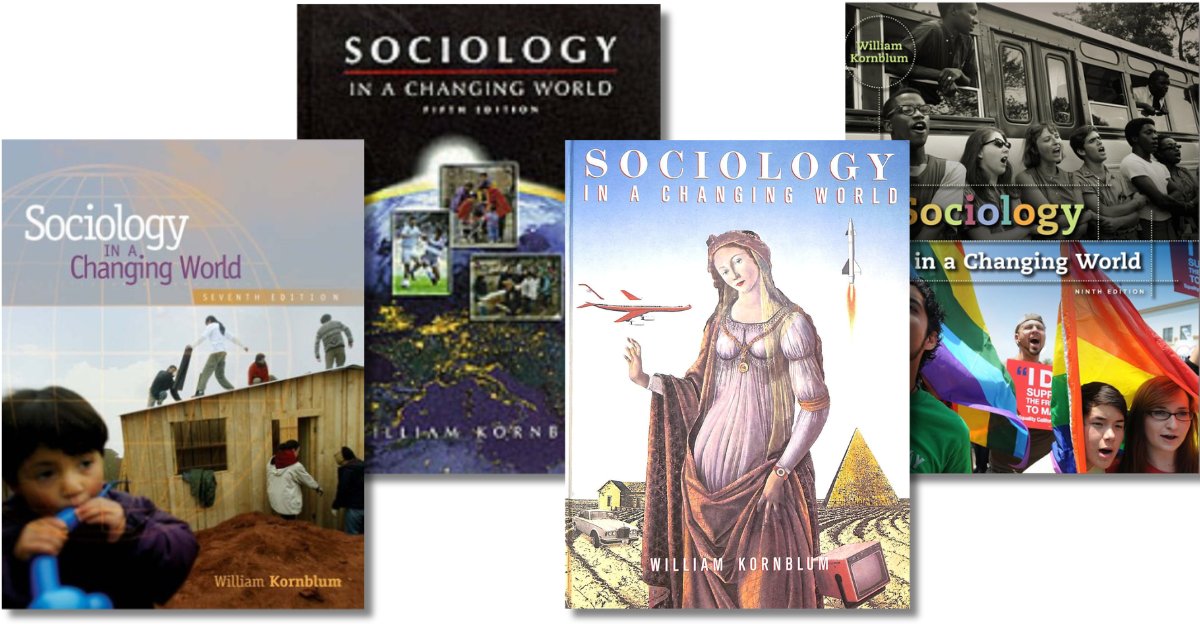
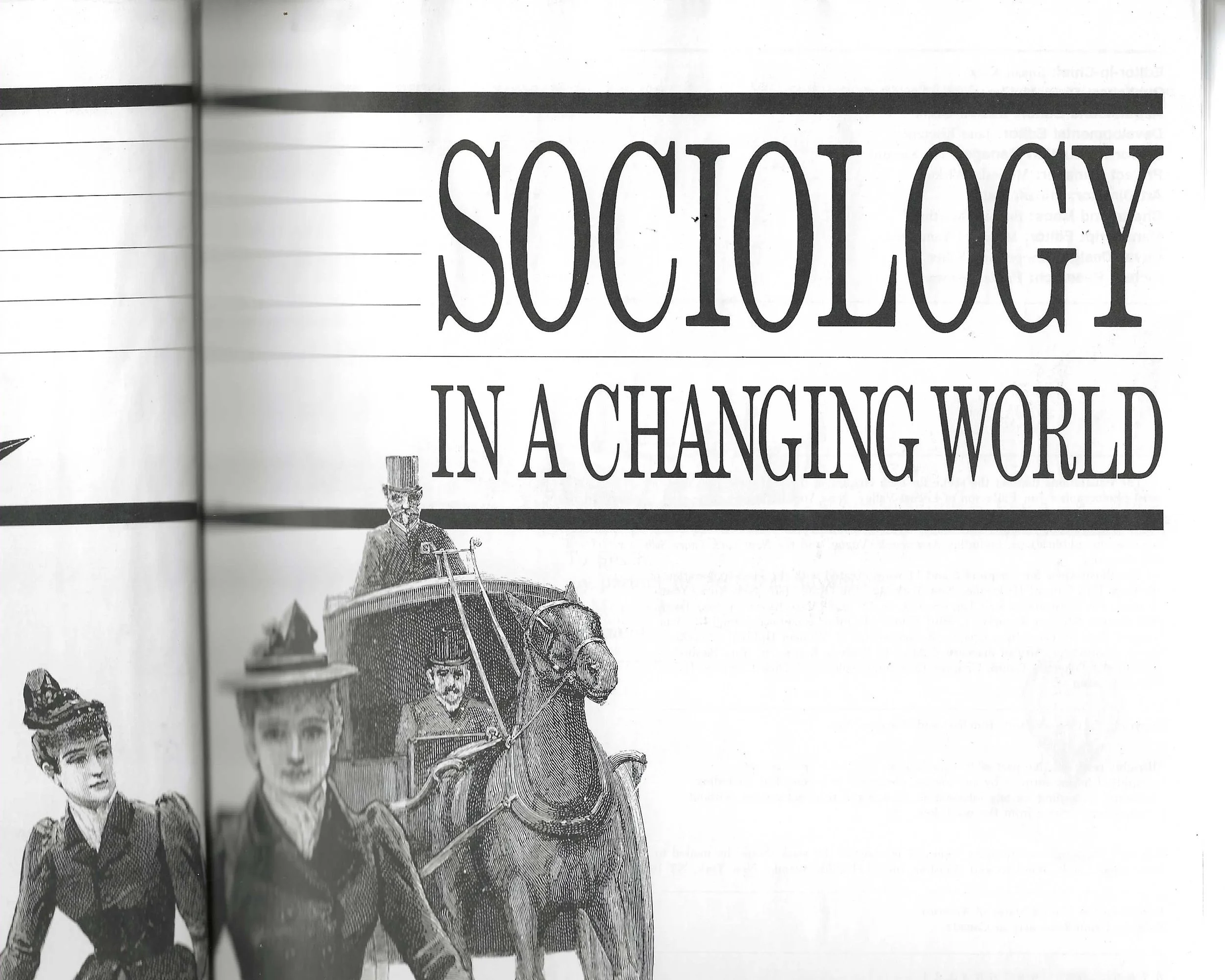
There were twenty onechapters in “the bigbook.” (Carolyn Smith and I, already had a top selling Social Problems text with eighteen chapters in that second sociology market.) When the new book finally appeared it had three years to show enough market potential to merit subsequent editions. Is there a buzz? Are adoptions coming in? How did it do in the first year? The second edition is the prize, in fact it is the very definition of a sine qua non. Fortunately, the first edition of Sociology … did quite well.. sold well over twenty thousand books.There was no agument about it going into further editions. But there was a consensus at the publisher’s, including from the sales people, that it needed “to be toned down in its design.”
I adored the first edition’s design. Our PUBLISHER HAD THE POWER. We “toned the book down.”
With textbooks almost all profits are made in the first year of sales when new books dominate. The used market takes over after that and by the third year the publisher hungers for a new edition to renew the profit cycle. For the authors that means ploughing up the current edition, and coming up with a newish table of contents, some new chapter ideas, or features in the chapters, and new design elements all to produce a credible revision that also respects reviewers’ criticisms. The author becomes tied to the book’s revision cycle. the way farmers are tied to the crop cycle, It’s relentless. One cannot procrastinate lest the entire enterprise languish.
Caroline and I produced nine editions of Sociology in a Changing World (27 years), and 12 editions of Social Problems (36 years In collaboration with Carolyn D. Smith, (Who made it all possible) Here's her account of our partnership:

In December 1981 I began work as a development editor in Prentice Hall’s Book Projects Division (BP). I was assigned to supervise the revision of a Social Problems textbook. Soon thereafter the author, Bill Kornblum, came to BP to attend a meeting in which we would plan the revision: what to update, what was out-of-date, how to acquire new photos, etc. Bill proposed to add a new Social Policy section to each chapter. I was impressed. An author wanting to do more work rather than less? Little did I know that that meeting would mark the beginning of a thirty-year partnership in which Bill and I would write, publish, and revise two major textbooks, along with several readers and ancillary materials, and a couple of trade books as well.
My office was located at 5th Avenue and 44th Street. Bill, a professor at the CUNY Graduate Center, had an office on 42nd Street not far from 5th Avenue. So it was an easy walk between our two offices. In those days before the internet, some of the material for the revision consisted of a lot of books and journals, with annotations on what sections/pages/paragraphs to use as a basis for updating the existing text. When that work was done, I would lug the books back, along with manuscript-in-progress, and ask him a bunch of questions. So we met often and gradually got to know each other, not only as author and editor but also as friends.
Around the same time, Bill and a colleague were planning to consolidate the results of various studies of children and adolescents growing up in impoverished environments. Bill asked me if I could integrate this material to create a unified work, a project that led to the development of a highly successful book titled Growing Up Poor.
Meanwhile Prentice Hall decided to integrate BP into its main office across the river, an impossible commute for me. I found a new job at TDI (Textbook Development Inc.), a startup company that would match potential textbook authors with publishers, with the proviso that TDI would develop and produce their texts.
What is textbook development? It’s a full-bore, hands-on approach to creating a text that provides instructors with everything they need to guide their students through their classes and assignments to a successful conclusion (i.e., a good grade). In other words, textbook development involves doing everything possible to create a “good” text, both in terms of content and pedagogy and in terms of marketability. For the development editor (DE), it involves working with the author and the publisher (and serving as liaison between them) on every aspect of the book: the content, the organization, the writing, the pedagogical aids (e.g., chapter outlines, summaries, key terms and definitions, review questions, etc.), the charts and photos, and much, much more. In the process the DE and the author can become very close – or can have a conflicted relationship that hampers the development process. In my thirty-plus years as a DE I experienced both ends of that continuum, as well as everything in between.
TDI’s main focus was on business and economics texts, and there were two such already lined up for development. I was working on them when Bill came to me and asked if TDI would be interested in developing an intro soc text. I said I would ask, and the answer was yes.
The process of getting a publisher to agree to publish an as-yet-unwritten textbook encountered obstacles of various kinds, notably publishers trying to corral Bill while excluding TDI. But finally we got Holt Rinehart to agree to publish Sociology in a Changing World (SIACW). Holt actually gave me a computer to use in editing the text. It was a blessing!
But it was not smooth sailing from that point. For one thing, Holt was taken over by Harcourt Brace, which already had an intro soc text. Bill and I were in agony as Harcourt considered taking on SIACW. In the end they did, and were unexpectedly supportive and agreeable as the book neared publication and sales.
In the meantime there were problems: office politics, for one, and an unexpected setback when the text was complete but the round of reviews required before production began were a bit disappointing and we were asked to make a number of changes. Some were OK, but in other cases Bill stuck to his guns and refused to modify certain portions “to meet the competition.” So, finally, after a rocky start, SIACW emerged into the academic world in 1987.
For me, the process could be summed up as trials, tribulations, and triumph, part of the triumph consisting of pride at the inclusion of my name on the title page: “In collaboration with Carolyn D. Smith.”
When I was working at TDI I had an office on Canal Street, so Bill and I, used to meeting in person, took countless subway rides between our two offices. Later, when I was employed at St. Martin’s and Macmillan, we would meet in Penn Station after our respective Long Island RR trains arrived, mine from Bayside and his from Long Beach. Why? Because our work was never finished. Both textbooks had to be revised every three years. So we were always working on one or the other of them.
At first we met in a grungy establishment called The Circus, which was also a hangout for several homeless men. I can’t resist finding it ironic that we were discussing social problems while surrounded by examples of one of the more egregious of those problems. We actually added a chapter on homelessness to Social Problems.
Thus Bill and I engaged in a 30-year partnership in which each of us was influenced by the other. I like to think I helped Bill make his writing calmer and more focused, and in some subtle way he seems to have made mine freer and more daring. Of course, royalties helped ease the costs of college for our kids, plus my daughter's wedding. Overall, we came to share our views of writing, publishing, and our goals relative to both. In short, as he put it, we became alter egos.
