Subway City: The International Express
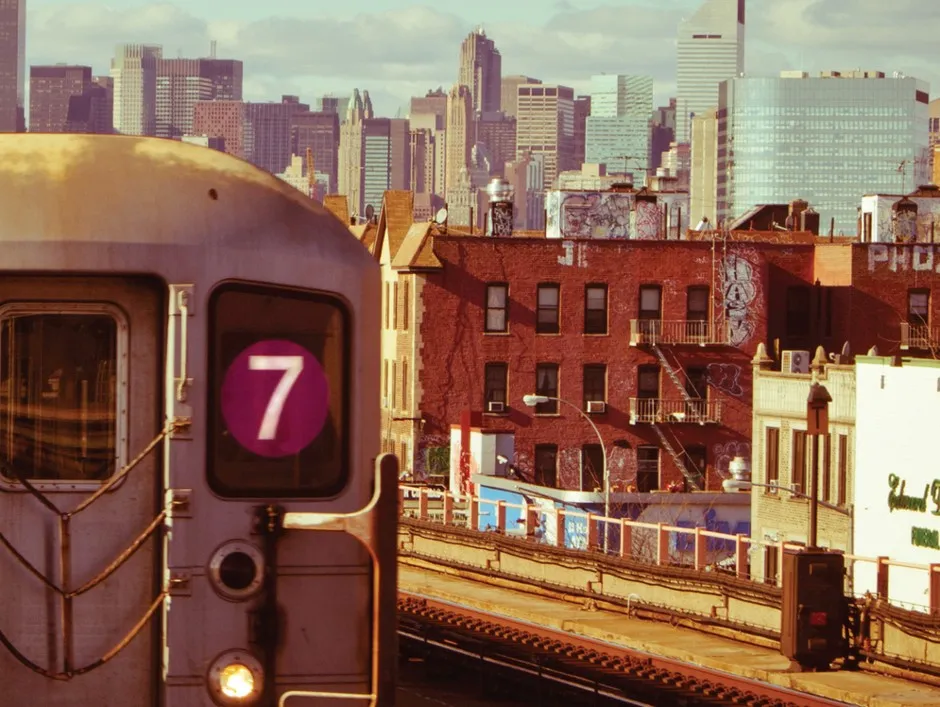
Nicknamed the International Express, the New York City Transit Authority 7 subway line runs through a highly diverse series of ethnic and immigrant neighborhoods in Queens.
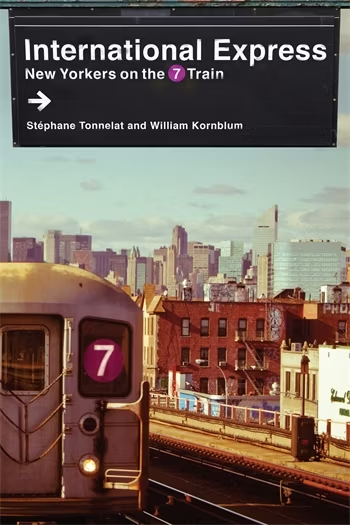
People from Andean South America, Central America, China, India, Italy, Korea, Mexico, Pakistan, Poland, Romania, and Vietnam, as well as residents of a number of gentrifying blue-collar and industrial neighborhoods, fill the busy streets around the stations. The 7 train is a microcosm of a specifically urban, New York experience, in which individuals from a variety of cultures and social classes are forced to interact and get along with one another. For newcomers to the city, mastery of life in the subway space is a step toward assimilation into their new home.
In International Express, the French ethnographer Stéphane Tonnelat and his collaborator William Kornblum, a native New Yorker, ride the 7 subway line to better understand the intricacies of this phenomenon. They also ask a group of students with immigrant backgrounds to keep diaries of their daily rides on the 7 train. What develops over time, they find, is a set of shared subway competences leading to a practical cosmopolitanism among riders, including immigrants and their children, that changes their personal values and attitudes toward others in small, subtle ways.

Dr. Stephan Tonnelat, Paris-CNRS, urban ethnographer "par excellence."
This growing civility helps newcomers feel at home in an alien city and builds what the authors call a "situational community in transit." Yet riding the subway can be problematic, especially for women and teenagers. Tonnelat and Kornblum pay particular attention to gender and age relations on the 7 train. Their portrait of integrated mass transit, including a discussion of the relationship between urban density and diversity, is invaluable for social scientists and urban planners eager to enhance the cooperative experience of city living for immigrants and ease the process of cultural transition.
Growing Up On The Subway
Becoming New Yorkers on the Subway
Salty Words from Mike Quill on the 1966 Transit Strike
The 1966 Transit Strike That Paralyzed NYC For Almost Two Weeks
New Yorkers of my parents generation believed in mass public transportation, the subways, the buses, the ferries. But did they ever stop complaining about them? New Yorkers are still complaining today (9/23/2025). Yet I do cherish the city’s mass transit on which, at age eleven, I became a New Yorker.
Daniel Kornblum, my father, was deeply involved with the subways. During our childhoods he was the city’s chief labor mediator, commissioner, and commuter. Fortunately, he was out office by the great subway strike of 1966.
My mother stopped me as I was leaving for school and explained that my father, who was already at work in his Manhattan office, had run out of batteries for his hearing aid. They had discussed the matter and decided that I was old enough, at age eleven, to bring them to his Manhattan office from our home in Queens. My father, then the Commissioner of Labor for the city, was calling from his office in the Municipal Building. He was involved in difficult negotiations; perhaps it was over the contract with the subway workers themselves. Without his hearing aid he could not continue his work. Our family home was in the Murray Hill neighborhood of Flushing and I had been to the city by subway from Main Street Flushing many times with my parents. They had taught me how to change trains from the #7 at Grand Central to the downtown #4 or #5 trains, in order to go to 33rd street where our family dentist practiced his arts of oral torture. But I had never continued on the Lexington avenue line further south. The assignment worried me, as I remember it now, but also made me feel, charged with a grown-up responsibility.
The long stairway from the Brooklyn Bridge Station reaches the street level under the arches of the Municipal Building itself. Generations of New Yorkers have come here to apply for marriage licenses or to pay traffic fines in nearby court buildings. But I was on a mission to save my father’s day. In my child’s mind the future of the city depended on me, all of which made it reasonable that I had missed school that day. Nor was I on a mundane mission to one of the endless green offices in the Municipal building where the public stood on lines to be married or licensed. I was ascending high in the building’s Victorian-style upper towers. From my father’s office I saw tugs plying the East River, barges filled with construction materials, a line of the subway cars seemed to glide silently across the Manhattan Bridge, in the distance there was the familiar dark span of the Queensboro Bridge.
My mission accomplished, I retraced the ride back to Grand Central, and then on the #7 to Flushing Main Street. I felt proud as if I was a kid beginning to “know his way around the city.”
